 Add to Chrome
 Add to Firefox
 Add to Edge
VISAFF: Speaker-Centered Visual Affective Feature Learning for Emotion Recognition in Conversation
May 18, 2026
Emotion Recognition in Conversation (ERC) is essential for effective human-machine interaction, aiming to identify speakers' emotional states in multi-turn dialogues. Early text-based methods struggle with complex scenarios like sarcasm because they inherently neglect vital non-verbal information. While recent Vision-Language Models (VLMs) address this by analyzing video directly, they are not inherently tailored for ERC and often focus on emotionally irrelevant background regions or passive listeners rather than the active speaker. Furthermore, fine-tuning these large models incurs prohibitive computational costs. Additionally, isolated visual signals are frequently ambiguous or technically compromised without the context of linguistic content and vocal prosody. To address these challenges, we propose VISAFF, a speaker-centered VISual AFFective feature learning framework for ERC. VISAFF consists of two stages: Speaker-Centered Affective Grounding and Reliability-Guided Affective Complementation. VISAFF utilizes a tuning-free approach to unlock the reasoning capabilities of frozen VLMs, efficiently steering them to focus on the active speaker's emotional visual cues without heavy training overheads. In the second stage, we introduce a reliability-guided affective complementation mechanism that dynamically leverages textual and acoustic modalities to compensate for visual uncertainty. Experiments on two real-world datasets demonstrate that VISAFF achieves highly competitive performance compared to state-of-the-art methods in a tuning-free setting, significantly enhancing computational efficiency by eliminating the need for expensive fine-tuning of large VLMs. The source code is available at https://anonymous.4open.science/r/speaker-2365/.

VAE-REPA: Variational Autoencoder Representation Alignment for Efficient Diffusion Training
Jan 25, 2026Denoising-based diffusion transformers, despite their strong generation performance, suffer from inefficient training convergence. Existing methods addressing this issue, such as REPA (relying on external representation encoders) or SRA (requiring dual-model setups), inevitably incur heavy computational overhead during training due to external dependencies. To tackle these challenges, this paper proposes \textbf{\namex}, a lightweight intrinsic guidance framework for efficient diffusion training. \name leverages off-the-shelf pre-trained Variational Autoencoder (VAE) features: their reconstruction property ensures inherent encoding of visual priors like rich texture details, structural patterns, and basic semantic information. Specifically, \name aligns the intermediate latent features of diffusion transformers with VAE features via a lightweight projection layer, supervised by a feature alignment loss. This design accelerates training without extra representation encoders or dual-model maintenance, resulting in a simple yet effective pipeline. Extensive experiments demonstrate that \name improves both generation quality and training convergence speed compared to vanilla diffusion transformers, matches or outperforms state-of-the-art acceleration methods, and incurs merely 4\% extra GFLOPs with zero additional cost for external guidance models.
Improving Region Representation Learning from Urban Imagery with Noisy Long-Caption Supervision
Nov 10, 2025Region representation learning plays a pivotal role in urban computing by extracting meaningful features from unlabeled urban data. Analogous to how perceived facial age reflects an individual's health, the visual appearance of a city serves as its ``portrait", encapsulating latent socio-economic and environmental characteristics. Recent studies have explored leveraging Large Language Models (LLMs) to incorporate textual knowledge into imagery-based urban region representation learning. However, two major challenges remain: i)~difficulty in aligning fine-grained visual features with long captions, and ii) suboptimal knowledge incorporation due to noise in LLM-generated captions. To address these issues, we propose a novel pre-training framework called UrbanLN that improves Urban region representation learning through Long-text awareness and Noise suppression. Specifically, we introduce an information-preserved stretching interpolation strategy that aligns long captions with fine-grained visual semantics in complex urban scenes. To effectively mine knowledge from LLM-generated captions and filter out noise, we propose a dual-level optimization strategy. At the data level, a multi-model collaboration pipeline automatically generates diverse and reliable captions without human intervention. At the model level, we employ a momentum-based self-distillation mechanism to generate stable pseudo-targets, facilitating robust cross-modal learning under noisy conditions. Extensive experiments across four real-world cities and various downstream tasks demonstrate the superior performance of our UrbanLN.
A Dataset for Spatiotemporal-Sensitive POI Question Answering
May 16, 2025Spatiotemporal relationships are critical in data science, as many prediction and reasoning tasks require analysis across both spatial and temporal dimensions--for instance, navigating an unfamiliar city involves planning itineraries that sequence locations and timing cultural experiences. However, existing Question-Answering (QA) datasets lack sufficient spatiotemporal-sensitive questions, making them inadequate benchmarks for evaluating models' spatiotemporal reasoning capabilities. To address this gap, we introduce POI-QA, a novel spatiotemporal-sensitive QA dataset centered on Point of Interest (POI), constructed through three key steps: mining and aligning open-source vehicle trajectory data from GAIA with high-precision geographic POI data, rigorous manual validation of noisy spatiotemporal facts, and generating bilingual (Chinese/English) QA pairs that reflect human-understandable spatiotemporal reasoning tasks. Our dataset challenges models to parse complex spatiotemporal dependencies, and evaluations of state-of-the-art multilingual LLMs (e.g., Qwen2.5-7B, Llama3.1-8B) reveal stark limitations: even the top-performing model (Qwen2.5-7B fine-tuned with RAG+LoRA) achieves a top 10 Hit Ratio (HR@10) of only 0.41 on the easiest task, far below human performance at 0.56. This underscores persistent weaknesses in LLMs' ability to perform consistent spatiotemporal reasoning, while highlighting POI-QA as a robust benchmark to advance algorithms sensitive to spatiotemporal dynamics. The dataset is publicly available at https://www.kaggle.com/ds/7394666.
GPT-Augmented Reinforcement Learning with Intelligent Control for Vehicle Dispatching
Aug 19, 2024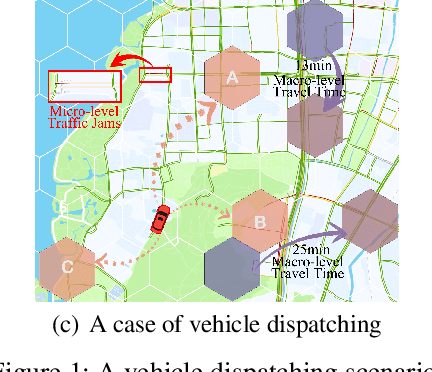
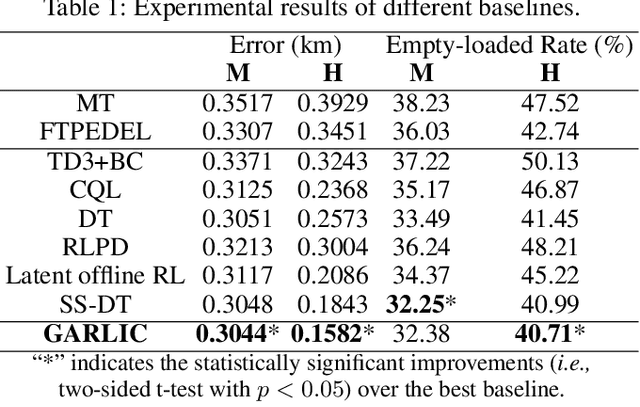
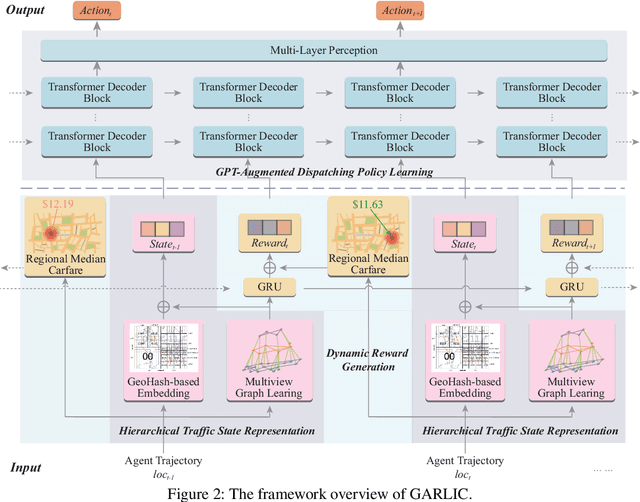
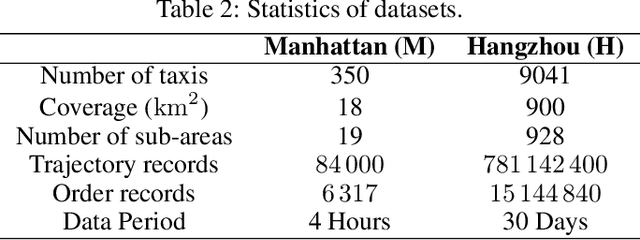
As urban residents demand higher travel quality, vehicle dispatch has become a critical component of online ride-hailing services. However, current vehicle dispatch systems struggle to navigate the complexities of urban traffic dynamics, including unpredictable traffic conditions, diverse driver behaviors, and fluctuating supply and demand patterns. These challenges have resulted in travel difficulties for passengers in certain areas, while many drivers in other areas are unable to secure orders, leading to a decline in the overall quality of urban transportation services. To address these issues, this paper introduces GARLIC: a framework of GPT-Augmented Reinforcement Learning with Intelligent Control for vehicle dispatching. GARLIC utilizes multiview graphs to capture hierarchical traffic states, and learns a dynamic reward function that accounts for individual driving behaviors. The framework further integrates a GPT model trained with a custom loss function to enable high-precision predictions and optimize dispatching policies in real-world scenarios. Experiments conducted on two real-world datasets demonstrate that GARLIC effectively aligns with driver behaviors while reducing the empty load rate of vehicles.